Training & Awareness

Training expert in Medical Radiation, Non-Destructive Testing, Radiation Safety & Health and Environmental Safety & Health.
SCHEDULED WASTE MANAGEMENT
Duration: 2 DAYS
COURSE INTRODUCTION
COURSE CONTENT
- Introduction to scheduled waste management
- Legislative and policy
- Identification, classification and properties of scheduled waste
- International convention
- Treatment and disposal methods for scheduled waste
- Licensing and inspection of scheduled waste
COURSE OBJECTIVE
- Explain the basic principles and definitions of the current legislation and regulations on scheduled wastes management.
- Understand groups and types of scheduled waste according to metals, inorganics, organics or their mixture with the application of Environmental Quality (Scheduled Wastes) Regulations, 2005.
- Have a better understanding of resource recovery, treatment and disposal methodologies.
- Understand the types of electrical scheduled waste (E-Schedule Waste).
WHO SHOULD ATTEND
GET IN TOUCH
- +60 19 - 888 4504
- No. 10 Jalan P10/19, Taman Industri Selaman, Seksyen 10, 43650 Bandar Baru Bangi, Selangor Darul Ehsan
- www.hgstraining.com
- 03-8926 7103
TENORM SAFETY AWARENESS
Duration: 1 DAYS
COURSE INTRODUCTION
COURSE OBJECTIVE
- To provide basic understanding of the philosophy and principles of radiation protection in NORM/ TENORM processing
- To create awareness on the effects of ionising radiation and safety working procedures related to NORM/ TENORM
- To familiarise with safe working procedures when dealing with NORM/ TENORM
WHO SHOULD ATTEND
COURSE CONTENT
- Fundamental of TENORM
- Basic information of radiation
- Dose limitation system
- TENORM hazards and biology effects
- Legislative requirement to TENORM
- Principle of TENORM protection
- Detection of radiation
- Work procedures for safe handling on TENORM decontamination
COURSE METHODOLOGY
- Participative lecture
- Discussion
HRD Corp Claimable: Payment is 100% based on per session and the certificate will only be released after full payment is received.
GET IN TOUCH
- +60 19 - 888 4504
- No. 10 Jalan P10/19, Taman Industri Selaman, Seksyen 10, 43650 Bandar Baru Bangi, Selangor Darul Ehsan
- www.hgstraining.com
- 03-8926 7103
Training expert in Medical Radiation, Non-Destructive Testing, Radiation Safety & Health and Environmental Safety & Health.
WE TAKE YOUR SKILLS TO THE NEXT LEVEL
HYDROGEN SULPHIDE (H2S) AWARENESS
Duration: 1/2 DAYS
COURSE INTRODUCTION
COURSE OBJECTIVE
- A clear knowledge of the dangers associated with H2S.
- The know-how of the use of safety equipment.
- To ensure a safe system of work.
- A safe means of escape in the event of H2S emergency.
WHO SHOULD ATTEND
All employees entering work sites with a potential of high concentrations H2S hazard, for them to be cautious, understand the risk of H2S exposure, and know what to do in the event of an H2S emergency.
COURSE CONTENT
- Introduction & Fundamental of Hydrogen Sulfide (H2S)
- H2S Characteristic
- Working Safely with H2S
- H2S Detection System
- Respiratory Protection Devices
- Contingency Plan, Emergency Roles and Responsibilities
COURSE METHODOLOGY
- Participative lecture
- Demonstration / Practical
GET IN TOUCH
- +60 19 - 888 4504
- No. 10 Jalan P10/19, Taman Industri Selaman, Seksyen 10, 43650 Bandar Baru Bangi, Selangor Darul Ehsan
- www.hgstraining.com
- 03-8926 7103
CARBON CAPTURE UTILITY AND STORAGE (CCUS)
Duration: 2 DAYS
To provide an overview of the drivers for CO2 capture and storage and to develop an understanding of the technology and techniques deployed in the execution of CCUS projects.
COURSE INTRODUCTION
WHY SHOULD ATTEND
LEARNING OUTCOME
By the end of the course, the delegate will be able to:
- Articulate why we need CO2 storage
- Explain CO2 properties and phase behaviour using a phase diagram.
- Describe different sources of CO2 and various technologies used for its capture.
- Predict CO2 transportation requirements and options
- Estimate subsurface reservoir storage capacity and suitability.
- Appreciate key economic drivers in CCUS
COURSE OUTLINE (DAY 1)
MODULE 1: What is CCUS?
- Climate Chang
- CO2 Emissions, historical and future forecasts
- World population and Energy demand growth
- Fossil fuels and other major sources of CO2
- Natural CO2 absorption and limitations
MODULE 2: Properties of CO2
- CO2 as a gas, a liquid and a solid
- CO2 Phase Diagram
- Predicting CO2 properties and behaviour in the CCUS process.
- Supercritical CO2
- The Joule Thomson Effect
MODULE 3: Carbon Capture
- Power Stations
- Other major CO2 sources: petrochemicals, agriculture, brewing etc.
- Capture Technologies: amine plants, direct extraction.
MODULE 4: CO2 Transportation
- Pipelines, operating conditions and material selection
- Corrosion.
- Tanker transport
- CO2 Hubs
COURSE OUTLINE (DAY 2)
MODULE 5: CO2 Storage
- Onshore or offshore, pros and cons
- Sub-surface storage options
- Geological Risks
- E&A Well Risks
- Permeability and Structural Capacity
- Reservoir Modelling
- Well location selection
- Well performance and related issues
- Storage Reservoir Performance, Monitoring and Management.
- Well and Field abandonment and long-term risk
MODULE 6: Economic Drivers
CO2 Trading Price and Economic drivers
- CAPEX, OPEX, ABEX and ongoing leakage monitoring.
MODULE 7: CO2 Storage Exercise
- Hypothetical subsurface storage reservoir
- Identification of key development risks
- Likely CO2 properties and phase behaviour
- Well numbers and location
- Development Costs and Economics
COURSE METHODOLOGY
- Participative Lecture
- Tutorial
- Practical / Exercise
GET IN TOUCH
- +60 19 - 888 4504
- No. 10 Jalan P10/19, Taman Industri Selaman, Seksyen 10, 43650 Bandar Baru Bangi, Selangor Darul Ehsan
- www.hgstraining.com
- 03-8926 7103
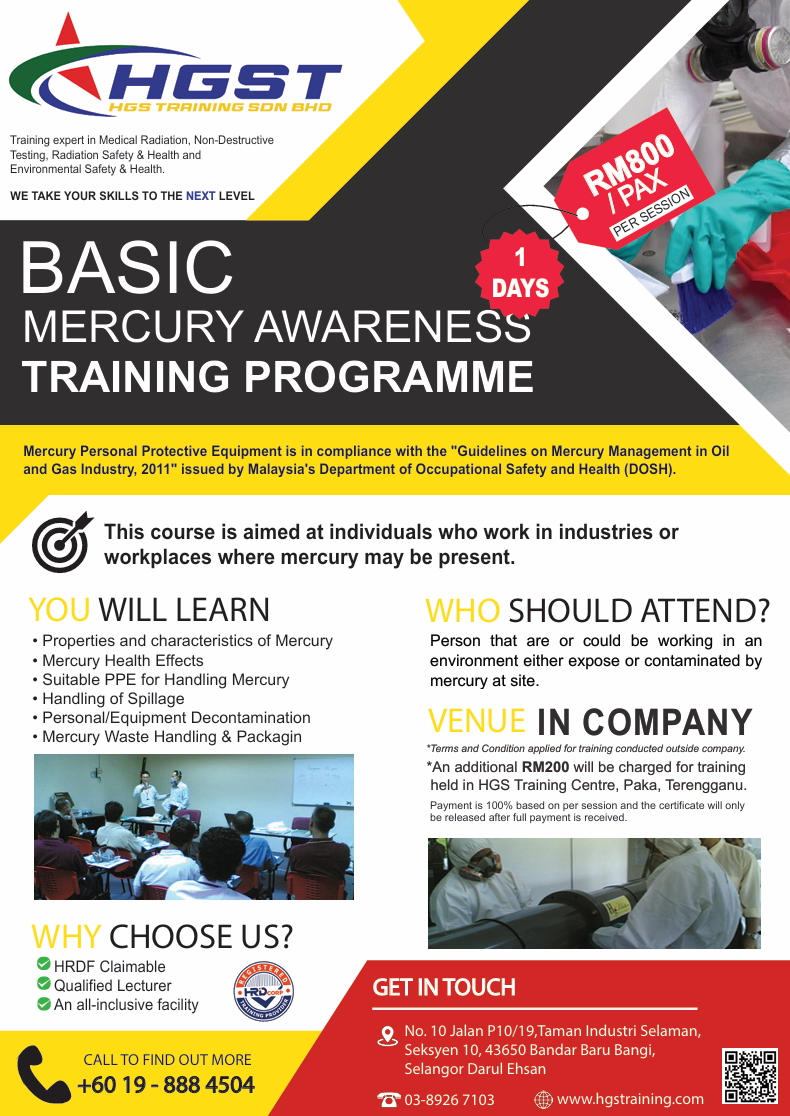
BASIC MERCURY AWARENESS TRAINING PROGRAMME
Duration: 1 DAYS
PRICE : RM800/PAX (PER SESSION)
- This course is aimed at individuals who work in industries or workplaces where mercury may be present.
YOU WILL LEARN
- Properties and characteristics of Mercury
- Mercury Health Effects
- Suitable PPE for Handling Mercury
- Handling of Spillage
- Personal/Equipment Decontamination
- Mercury Waste Handling & Packaging
WHO SHOULD ATTEND?
VENUE IN COMPANY
WHY CHOOSE US?
- HRDF Claimable (HRD Corp Registered Provider)
- Qualified Lecturer
- An all-inclusive facility
GET IN TOUCH
- +60 19 - 888 4504
- No. 10 Jalan P10/19, Taman Industri Selaman, Seksyen 10, 43650 Bandar Baru Bangi, Selangor Darul Ehsan
- www.hgstraining.com
- 03-8926 7103
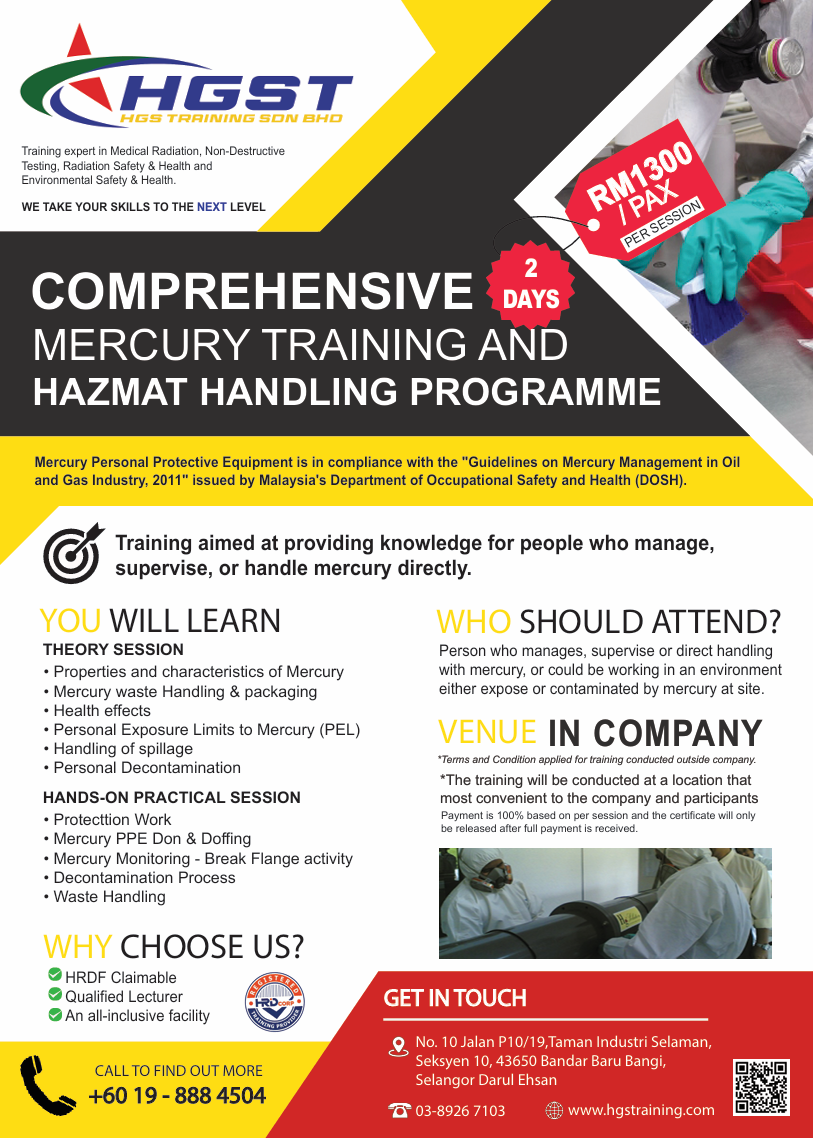
COMPREHENSIVE MERCURY TRAINING AND HAZMAT HANDLING PROGRAMME
Duration: 2 Days
PRICE : RM13000/PAX (PER SESSION)
- Training aimed at providing knowledge for people who manage, supervise, or handle mercury directly.
YOU WILL LEARN
- Properties and characteristics of Mercury
- Mercury waste Handling & packaging
- Health effects
- Personal Exposure Limits to Mercury (PEL)
- Handling of spillage
- Personal Decontamination
Hands-on Practical Session
- Protection Work
- Mercury PPE Don & Doffing
- Mercury Monitoring – Break Flange activity
- Decontamination Process
- Waste Handling
WHO SHOULD ATTEND?
VENUE IN COMPANY
WHY CHOOSE US?
- HRDF Claimable (HRD Corp Registered Provider)
- Qualified Lecturer
- An all-inclusive facility
GET IN TOUCH
- +60 19 - 888 4504
- No. 10 Jalan P10/19, Taman Industri Selaman, Seksyen 10, 43650 Bandar Baru Bangi, Selangor Darul Ehsan
- www.hgstraining.com
- 03-8926 7103
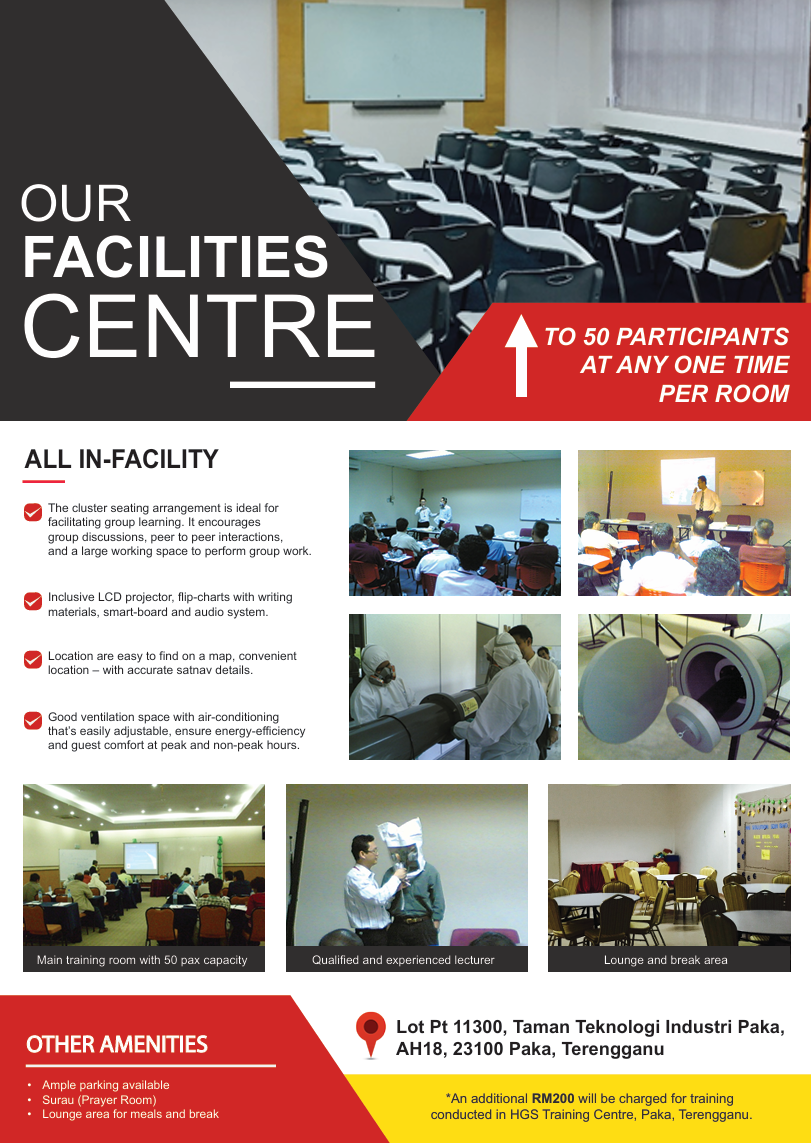
OUR FACILITIES CENTRE
Capacity: Up to 50 participants at any one time per room.
ALL IN-FACILITY
- The cluster seating arrangement is ideal for facilitating group learning. It encourages group discussions, peer to peer interactions, and a large working space to perform group work.
- Inclusive LCD projector, flip-charts with writing materials, smart-board and audio system.
- Location are easy to find on a map, convenient location – with accurate satnav details.
- Good ventilation space with air-conditioning that's easily adjustable, ensure energy-efficiency and guest comfort at peak and non-peak hours.
FACILITY HIGHLIGHTS
- Main training room: 50 pax capacity.
- Qualified and experienced lecturer: Professional guidance for all sessions.
- Lounge and break area: Dedicated space for meals and relaxation.
OTHER AMENITIES
- Ample parking available
- Surau (Prayer Room)
- Lounge area for meals and break
LOCATION & PRICING
- Address: Lot Pt 11300, Taman Teknologi Industri Paka, AH18, 23100 Paka, Terengganu.
- Note: An additional RM200 will be charged for training conducted in HGS Training Centre, Paka, Terengganu.